
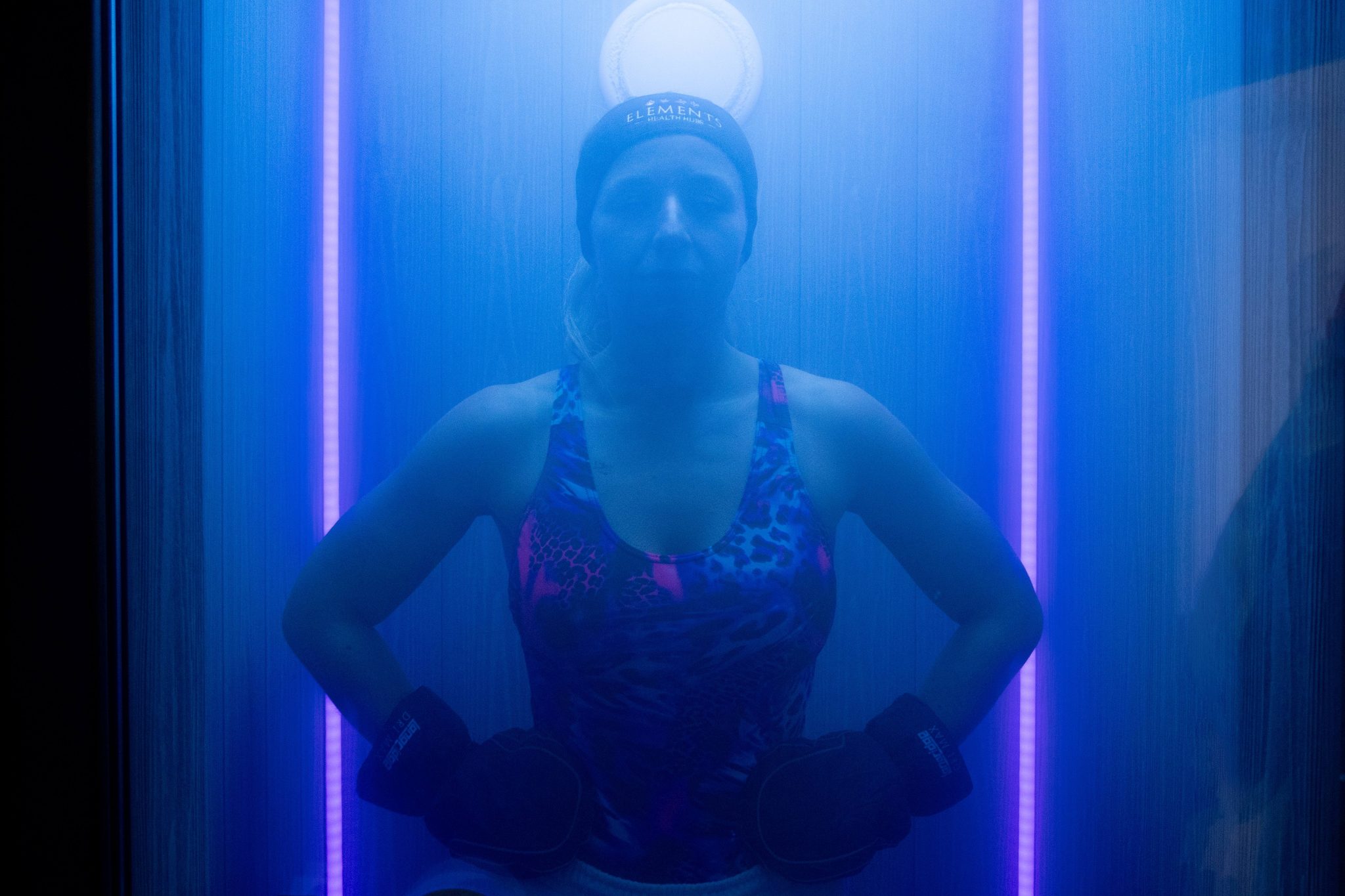
Everyone knows, and dreads, the after workout soreness. The achy legs that make climbing stairs a nightmare, or the painful abs that make a sneeze feel like hard work. While some champion it as a sign of a great workout, others want to avoid it as much as possible. So, can you reduce it? And does cryotherapy help with muscle soreness?
Of course, this is a normal part of exercise, especially when you hit the workout hard, and is referred to as Delayed Onset Muscle Soreness (DOMS).
Cryotherapy is an emerging treatment being used to help speed up and enhance muscle recovery after a workout. While scientific studying is still in its infancy, the overall theme seems to suggest that cryotherapy after exercise may help perceived muscle soreness and discomfort after a workout. Currently, it is suggested to be particularly effective for those training frequently or who have sessions or events close together.
In this article, we will look at how cryotherapy for muscle recovery can work, the potential benefits, when to use it and where it fits into your overall recovery plan.
What Causes Muscle Soreness After Exercise?
What is DOMS?
DOMS, short for Delayed Onset Muscle Soreness, typically develops after exercise. Usually, you will experience it after trying something new, after a particularly intense workout, or after taking a break for a little while and getting back into the swing of things.
Common symptoms include:
- Soreness
- Tenderness
- Stiffness
Why do muscles become sore?
So what causes it? Most people believe it is the build up of lactic acid that causes the pain the following few days. This is part of it, but it isn’t the whole story.
You will likely know, and have felt, that exercise puts stress on your muscles. Whether it be walking, running, lifting weights or any other form of exercise, your muscles are working hard.
When put through challenging or unfamiliar movements, muscles can experience microscopic muscle disruption. This is to say that the tiny fibres that make up your muscles tear slightly.
This sounds scary, but it is important to remember that your muscles grow as your body repairs those tears.
Unfortunately, as your body repairs these tiny tears, your body experiences the soreness.
Does Cryotherapy Help With Muscle Soreness?
Cryotherapy may help reduce perceived muscle soreness and discomfort following strenuous exercise, although the extent of the benefit can vary depending on the individual and the type of cryotherapy used.
How cryotherapy may help
Like a lot of benefits of cryotherapy, cryotherapy for muscle recovery is not a guarantee. Different people will react differently to the therapy, and research into it is still early in its journey.
But what we do know is how cryotherapy works.
The cold exposure means blood vessels in the body constrict (vasoconstriction). This decreases blood flow to stressed limbs which reduces temporary inflammation and swelling. As your body warms up, the vessels open up again, bringing oxygen-rich blood to the areas where it was restricted. This could help muscle recovery.
On top of this, the cold can reduce nerve conduction velocity, which is how fast signals travel from nerves to your brain. This can raise your pain threshold so you feel like your muscles hurt less.
Finally, the cold exposure can lower stress hormone levels and trigger endorphin releases, potentially improving your mood, and post-workout relaxation.
All of this is to say that cryotherapy after exercise may lead to:
- Potential reduction in pain or discomfort
- Potential reduction in feeling stiff
- Potential mood boost
Feeling less sore isn’t the same as complete recovery
However, it would be remiss of us not to say the following:
Feeling less sore after workout, does not mean complete recovery.
Your muscles will still be in the process of mending the tears, building up energy, strength, and function. Plus, there will be tissue repair also needed.
Benefits of Cryotherapy After Exercise
There are a number of believed benefits of cryotherapy after exercise.
May help muscle soreness
Thanks to the impact on the body, cryotherapy after exercise is starting to be used because it is believed to reduce the perceived soreness and discomfort of DOMS. While this does not necessarily mean that the muscles are physically repairing faster, feeling less sore and more comfortable can still be a useful part of the recovery process.
May ease post-exercise stiffness and discomfort
Alongside soreness, it is common to experience stiffness after a particularly challenging workout. You might find that your legs feel heavy when you get out of bed, or that everyday movements feel a little more difficult than usual.
Cryotherapy may help to reduce this feeling of discomfort, making it easier to move around and get on with your day following exercise.
For people who train regularly, this can be particularly useful. If you have another training session, match or event coming up soon, managing post-workout soreness and stiffness can help you feel more comfortable going into your next session.
May support feelings of recovery
Recovery is not just about what is happening inside your muscles. How recovered you feel can also have a big impact on how ready you are to get moving again.
The cold exposure associated with cryotherapy may help you feel less sore and more refreshed after strenuous exercise. This can make it a useful addition to a wider recovery routine, particularly for people who exercise frequently.
It is important to remember, however, that feeling recovered does not necessarily mean your muscles have completely recovered. Cryotherapy should therefore be viewed as one potential recovery tool, rather than a replacement for proper rest and recovery.
May be useful when training sessions are close together
For someone who exercises once or twice a week, there may be plenty of time between workouts for their muscles to recover naturally.
For athletes and people who train frequently, it can be a different story.
If you have several training sessions in a week, compete in multiple events over a weekend, or have another demanding workout shortly after your previous one, managing soreness and discomfort can become more important.
This is where cryotherapy for muscle recovery may have a role. By potentially helping to reduce perceived soreness and discomfort, it can form part of a recovery routine between sessions.
Cryotherapy for Recovery Between Training Sessions
When you train regularly, recovery becomes just as important as the training itself.
Your body needs time to adapt to exercise and recover from the physical demands you place on it. If you are continually training without allowing enough time for recovery, soreness and fatigue can build up and potentially affect how you feel during your next session.
Cryotherapy is one option that some athletes and regular exercisers use as part of this process.
It may be particularly appealing when there is a short window between training sessions or events. For example, an athlete competing across a weekend may want to manage post-event soreness before their next competition. Similarly, someone following an intensive training programme may use cryotherapy alongside other recovery methods.
The important thing is not to think of cryotherapy as a way to bypass recovery altogether. Instead, it can be considered one part of a wider approach to helping your body recover between periods of exercise.
When Should You Have Cryotherapy After Exercise?
There is no single answer that will apply to everyone when it comes to the best time for cryotherapy after exercise. The timing can depend on the individual, the type of exercise they have completed and what they want to get out of their recovery routine.
Immediately after exercise
Some people choose to have cryotherapy shortly after completing a demanding workout or event.
The idea is to incorporate it into the recovery period while post-exercise soreness and discomfort are beginning to develop. This can be particularly relevant following strenuous exercise or when another session is coming up soon.
Later in the day
Cryotherapy does not necessarily have to be the first thing you do after leaving the gym.
Depending on your routine, you may choose to have a session later in the day when you have finished work, training or other commitments. The important thing is to consider it as part of your overall recovery routine rather than focusing solely on a narrow window immediately after exercise.
On a recovery day
Cryotherapy muscle recovery can also form part of a recovery day.
If you have a rest day between demanding workouts, you may choose to use this time to focus on recovery through a combination of rest, appropriate movement, good nutrition, hydration and other strategies that help you feel ready for your next session.
Who Might Consider Cryotherapy for Muscle Recovery?
Cryotherapy is not something that everyone needs after every workout. However, it may be particularly relevant for people who regularly put their bodies through demanding physical activity.
This could include:
- Athletes who train or compete regularly
- Gym-goers completing challenging strength or conditioning sessions
- Runners and cyclists with frequent training sessions
- Team-sport players with training and matches close together
- People taking part in multiple events, such as tournament or race weekends
- Anyone experiencing post-exercise soreness who is looking for additional ways to support their recovery
For these people, the potential benefit may be less about avoiding every bit of muscle soreness and more about feeling comfortable and ready to get back to their usual activities.
What Does the Research Say About Cryotherapy and Muscle Recovery?
Research into cryotherapy and exercise recovery has looked at whether cold exposure can influence muscle soreness, discomfort and other measures of recovery.
Overall, there is evidence to suggest that some forms of cold therapy may help reduce perceived muscle soreness following strenuous exercise. However, the results are not always consistent, and research has looked at different types of cryotherapy, temperatures, treatment durations and exercise protocols.
This makes it difficult to say that cryotherapy will have exactly the same effect for everyone.
It is also important to distinguish between feeling less sore and physically recovering faster. A reduction in perceived soreness does not necessarily mean that muscle tissue has repaired more quickly or that all aspects of exercise recovery have been accelerated.
So, while cryotherapy may have a role in helping people manage post-exercise soreness and their overall perception of recovery, it should not be viewed as a guaranteed shortcut to complete muscle recovery.
Cryotherapy as Part of a Wider Recovery Routine
While cryotherapy may be useful, it is only one piece of the recovery puzzle.
Getting enough sleep, eating a balanced diet, staying hydrated and giving your body enough time to recover between demanding workouts are all important. Your training programme also matters. Gradually increasing the intensity and volume of your exercise can give your body time to adapt rather than placing too much stress on it too quickly.
Light movement or active recovery may also help some people feel less stiff following exercise.
Think of cryotherapy as something that can complement these habits, rather than replace them. A good recovery routine should start with the basics, with treatments such as cryotherapy potentially added according to your individual needs and preferences.
What Our Customers Say About Cryotherapy for Recovery
Everyone’s experience with cryotherapy is different, but hearing from people who incorporate it into their own exercise and recovery routines can help show how it may fit into everyday life.
“I have really enjoyed doing Cryotherapy at Elements over the last year or so. I feel like it has massively improved my recovery between sessions and matches, whilst improving my sleep quality too. I try to do Cryotherapy at least once or twice a week depending on my availability, and I always come away feeling more energised after coming out of the chamber. I would highly recommend Cryotherapy at Elements to anyone, regardless of their health and fitness goals”.
– Callum Baughan, Winchester City FC Footballer
Of course, an individual experience is just that—individual. What works well for one person may not feel the same for someone else.
If you are interested in learning more about cryotherapy for muscle recovery, book a tour with our team. We will talk you through our first-of-its-kind in the UK chamber, and what you can expect from a session.
Plus, we’ll explain how our memberships work, and the other therapies you’ll have access to, such as our clinically controlled sauna, ice bath and hyperbaric oxygen chamber.